Polycarbonate Ventilator: Power-Free Ventilation for Large Spaces
A hot, humid, and poorly ventilated workspace can affect both comfort and productivity. In large industrial buildings, warehouses, and commercial facilities, heat and moisture can build up quickly, while smoke, odors, and chemical fumes may remain trapped indoors. Traditional ventilation systems can address these issues, but they may also require electricity, wiring, and regular operating costs.
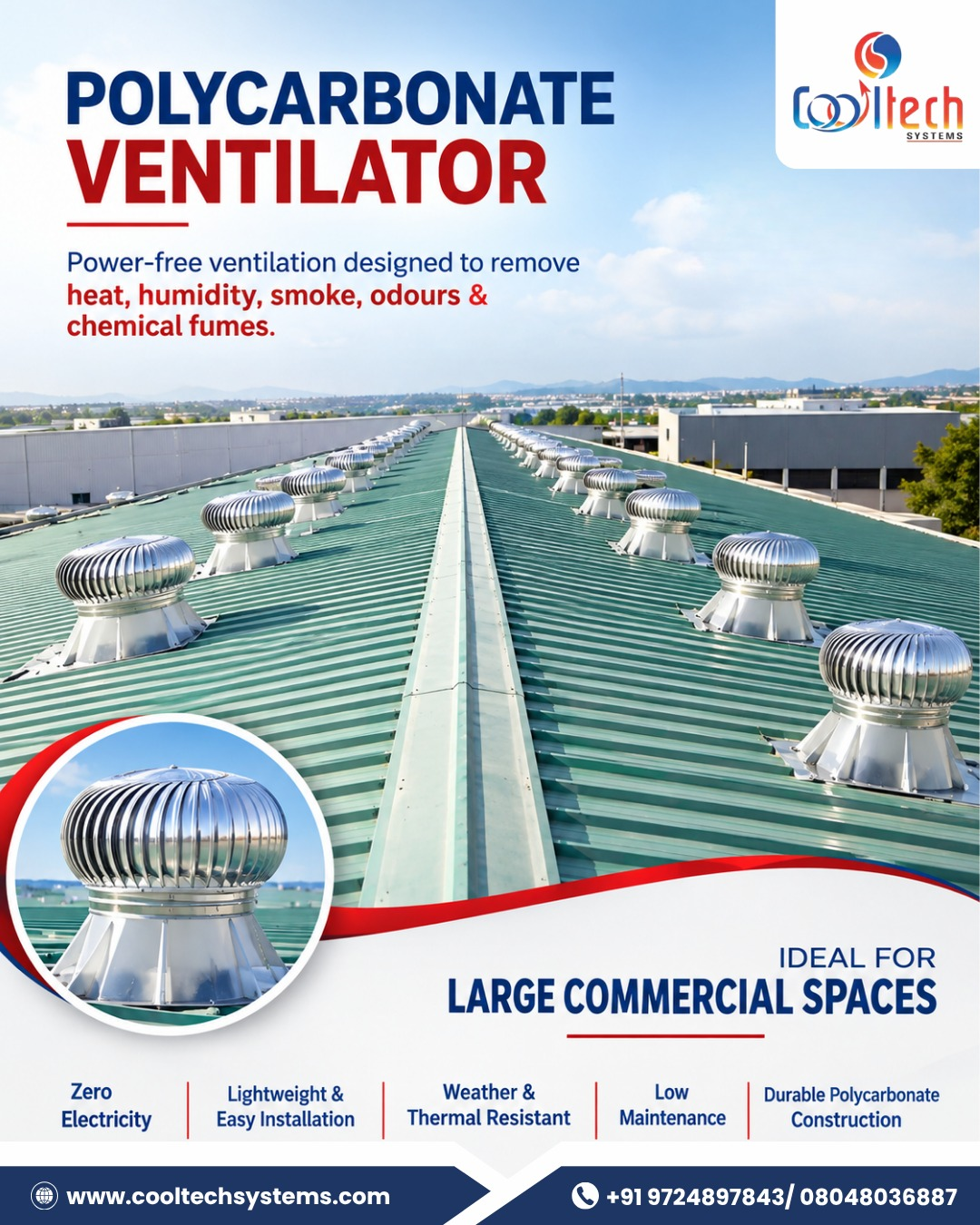
A Polycarbonate Ventilator offers a practical alternative for facilities looking for natural, power-free air movement. Designed to work with airflow and pressure differences, these roof-mounted ventilators help remove accumulated hot air and unwanted indoor pollutants without electricity.
CoolTech Systems provides ventilation solutions designed for large commercial and industrial spaces where effective air circulation is an important part of the building environment.
What Is a Polycarbonate Ventilator?
A Polycarbonate Ventilator is a roof-mounted ventilation device designed to encourage the continuous escape of hot and stale air from an enclosed building. Polycarbonate construction provides a lightweight yet durable solution for demanding roof applications.
As warm air naturally rises, it accumulates near the roof. The ventilator provides an outlet for this trapped air to move outside, allowing fresher air to enter through available openings elsewhere in the building.
The result is a more naturally ventilated indoor environment without relying on electrically powered exhaust fans.
How Power-Free Ventilation Works
The biggest advantage of a power-free ventilation system is its simple operating principle.
As temperatures inside a building rise, warm air becomes lighter and moves upward. The roof-mounted ventilator uses this natural movement to help release accumulated heat and air from the building.
Wind movement around the roof can further support airflow through the ventilator. Because the system does not require a motor or electrical connection, it can operate continuously under suitable environmental conditions.
This makes power-free ventilation particularly useful for facilities with large roof areas and high internal heat loads.
Removing Heat, Humidity and Unwanted Air
Industrial and commercial buildings can face several ventilation challenges at once. Machinery may generate heat, manufacturing processes can create fumes, and humid environments can become uncomfortable over time.
A well-planned industrial roof ventilator can help remove:
- Excess heat
- Humid and stagnant air
- Smoke
- Unpleasant odours
- Certain process-related fumes
- Warm air accumulated near the roof.
A roof ventilator is part of an overall ventilation strategy. The building should also have suitable openings or fresh-air pathways so that exhausted air can be replaced effectively.
Why Polycarbonate Construction Matters
Material selection is important when ventilation equipment is installed on an exposed rooftop. A ventilator needs to withstand changing outdoor conditions while remaining practical to install and maintain.
Polycarbonate is lightweight and well-suited for applications that require durability and weather resistance. The product shown by CoolTech Systems combines durable polycarbonate construction with a lightweight design.
This makes installation easier while reducing the structural load associated with heavier equipment.
Ideal for Large Commercial and Industrial Spaces
Large buildings often have substantial heat loads and considerable roof areas. Installing ventilation at roof level can help target one of the main locations where hot air accumulates.
A roof ventilator can be considered for applications such as:
Manufacturing Facilities
Production processes and machinery can increase indoor temperatures. Natural roof ventilation can help release accumulated heat.
Warehouses
Large warehouses can become warm, particularly during sunny weather. Roof-level ventilation provides a passive way to help remove hot air.
Workshops
Workshops with equipment and ongoing activities can benefit from improved circulation and the removal of warm, stagnant air.
Factories
Industrial processes may generate heat, smoke, or odors. A properly designed ventilation system can form part of the facility’s broader air-management strategy.
Commercial Buildings
Large commercial spaces can use passive ventilation to improve general air movement without continuously powering exhaust equipment.
Key Benefits of CoolTech Systems’ Ventilator
The ventilation solution highlighted by CoolTech Systems is designed around several practical advantages:
Zero Electricity:
The power-free design does not require an electrical motor to operate.
Lightweight Construction:
The lightweight structure can make rooftop installation more convenient.
Weather & Thermal Resistance:
The ventilator is designed for outdoor rooftop conditions and exposure to changing temperatures.
Low Maintenance:
With no motor or complex electrical drive system, routine maintenance requirements can be simpler than those of powered exhaust equipment.
Durable Polycarbonate Construction:
The construction is intended to balance durability with lightweight performance.
Choosing the Right Ventilation Solution
Before installing roof ventilators, businesses should evaluate the building's size and layout, internal heat generation, roof configuration, prevailing wind conditions, and available fresh-air intake.
Ventilator quantity and placement should also be planned according to the building’s specific requirements. Simply adding units without considering air-entry points and internal airflow may not deliver the expected result.
For facilities dealing with significant heat, humidity, smoke, or fumes, a professional assessment can help determine whether to use passive roof ventilation alone or alongside mechanical ventilation.
A Practical Step Toward Better Airflow
Ventilation does not always have to depend entirely on powered equipment. By using natural airflow and the tendency of warm air to rise, power-free roof ventilation can provide a straightforward approach to improving air movement in suitable buildings.
For large industrial and commercial spaces, the combination of zero electricity consumption, lightweight construction, low maintenance, and durable materials makes a Polycarbonate Ventilator a practical option.
CoolTech Systems focuses on ventilation solutions designed to support better airflow in demanding commercial and industrial environments. With the right installation strategy, passive roof ventilation can become an important part of a facility’s overall heat and air-management plan.
Frequently Asked Questions
1. Where can a Polycarbonate Ventilator be used?
A Polycarbonate Ventilator can be used in suitable industrial and commercial spaces such as factories, warehouses, workshops, manufacturing units, and other large buildings that require natural heat and air extraction.
2. Does a power-free ventilator require electricity?
No. A power-free ventilator is designed to operate without an electrical motor. It uses natural airflow, rising warm air, and suitable environmental conditions to help exhaust hot and stagnant air from the building.
Keywords